Mathematics
At Stalyhill Infant School, our teaching centres around fostering a confidence in maths knowledge through an engaging and progressive curriculum. We want our children to learn more and remember more.
We follow the White Rose Maths Scheme of Learning which through its mastery design, structure and sequence sets out the knowledge and skills that children will acquire as they progress through our school.
Pupil voice indicates that Maths is one of the most loved subjects in our school and our curriculum builds upon previous learning, embedded knowledge and the use of mathematical vocabulary. We want children to make rich connections across mathematical ideas and the wider curriculum so that they develop fluency, mathematical reasoning, and efficiency in solving problems.
We promote a culture of taking risks and embracing challenges; our children develop perseverance and resilience skills. They are motivated to work together and independently to tackle anything! Staff use assessment opportunities to address misconceptions and provide children with relevant and constructive feedback in order to support future learning.
Manipulatives and mathematical representations are used to support children when engaging with mathematical concepts and structured interventions provide additional support to those children who need it.
Maths at Stalyhill Infant School encourages our pupils to have the confidence to apply their mathematical knowledge to other subjects and to know that maths is essential to everyday life, critical to science, technology and engineering, and necessary for financial literacy.
We aim that all pupils:
-
Become fluent in the fundamentals of mathematics so that they develop conceptual understanding and the ability to recall and apply knowledge rapidly and accurately.
-
Can solve problems by applying their mathematics to a variety of problems with increasing sophistication, including in unfamiliar contexts and to model real-life scenarios.
-
Can reason mathematically by following a line of enquiry and develop and present a justification, argument or proof using mathematical language.
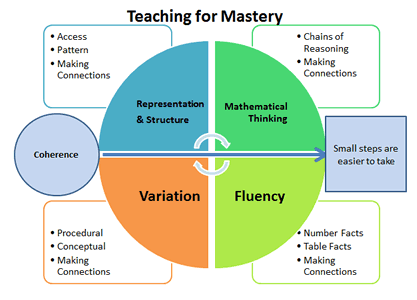
A central component in our intent, through our partnership with mastery specialists in the Turing NW maths hub, has been discussion of the NCETM’s five big ideas in mastery, drawn from research evidence, underpinning teaching for mastery. We draw upon the diagram below to help bind these ideas together and inform our professional practice.